Seven months into the war with Iran and its regional proxies, energy markets remain at center stage. Like all wars involving commodities, effects on the energy markets have been inconsistent and have confounded the most astute analysts.
Viewed from the perspective of crude oil only, the war has not produced the crude oil price and volatility levels predicted early in the conflict. As I pointed out in a previous blog (Crude Oil: Old News?), “Brent’s absolute price and volatility levels have not been notable on a historical basis. Frequent rumors of an impending ceasefire dampened both price and implied volatility.” Instead, the crude oil market seems to be caught up in a cycle of gradual price increases followed by sudden and rapid declines. We shall see whether the current move over $100/bbl. in the face of continuing supply disruption breaks the cycle. In any case, it might not even be the most important factor to consider.
Although crude oil attracts the most attention, the war’s most consequential effects are emerging elsewhere in the energy complex. By far the most dramatic and explosive situation is playing out in refined products, specifically diesel (ULSD, Ultra-low Sulphur Diesel). This is reflected in ULSD’s price, implied volatility skews, and most importantly, refining spreads. The situation is extreme.
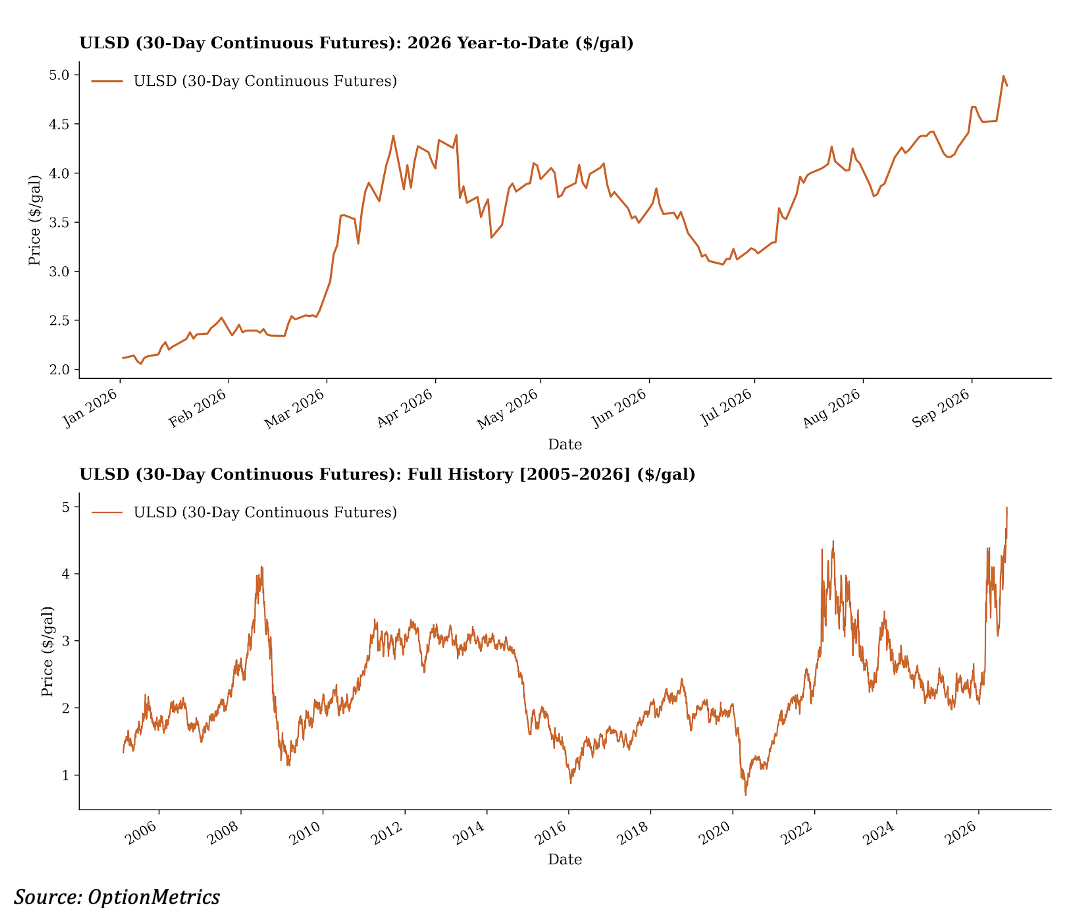
Fundamentally, the current situation in diesel is the classic case of constrained supply and inelastic demand. Severe global refining bottlenecks have been exacerbated due to the long-term shortage of refining capacity and, in the short term, by supply disruptions due to the wars in Iran and Ukraine. This has led to historically low inventories and severe futures backwardation (i.e., prompt months are more expensive than deferred), making it extremely expensive to replenish short-term buffers. US exports have made the situation even worse in the face of relatively inelastic global commercial demand.
The result has been an explosion in diesel prices to all-time highs, well above the previous peaks reached in June 2022:
Diesel’s implied volatility is high at 58.3% but nowhere near its peak of 117.3% reached last March 12th. However, that doesn’t tell the whole story. After a few months of expanding and contracting, ULSD’s call skew (0.20 – 0.50 delta implied volatility) is extremely steep and the highest it has been since the beginning of the war:
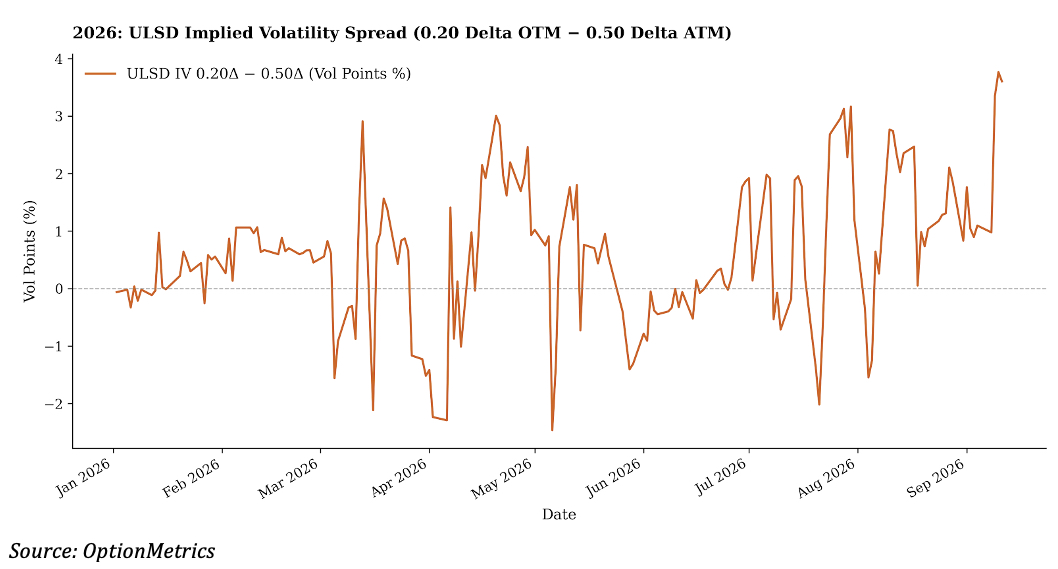
The skew is a symptom of the most significant feature of the war so far: all-time record high diesel refinery margins, or crack spreads. Defined as the difference in price between the refining input and output (in this case, crude oil and diesel), they are an accurate reflection of a refined product’s supply/demand balance. Below is the 1:1 diesel crack spread, i.e., one barrel of crude oil is used to make one barrel of diesel for 2026. [Please note that all spread levels displayed below may vary from other sources due to the use of 30-day continuous crude oil and ULSD futures.]
As you can see below, the 1:1 diesel crack spread is at the highest level since the war began and is currently at all-time record levels:
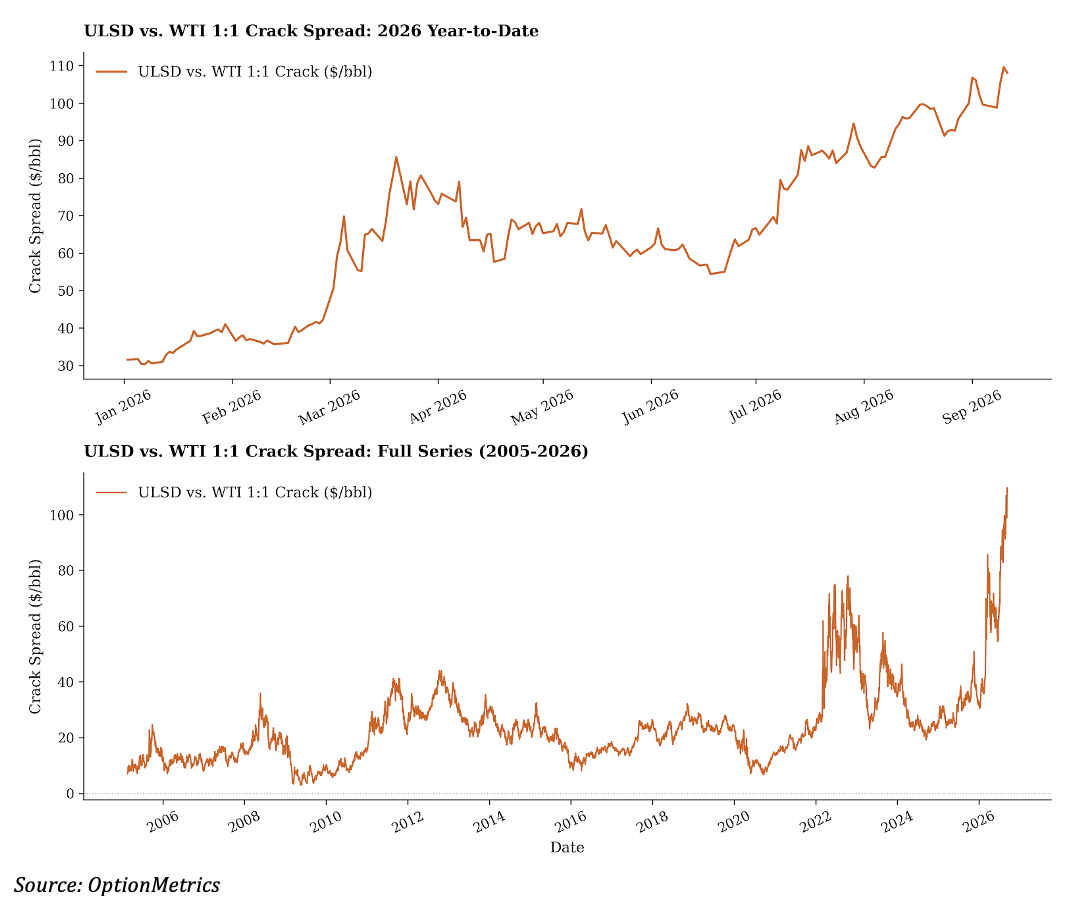
As you can see, the 1:1 diesel crack has been making new all-time highs since mid-Summer and continues to shoot up.
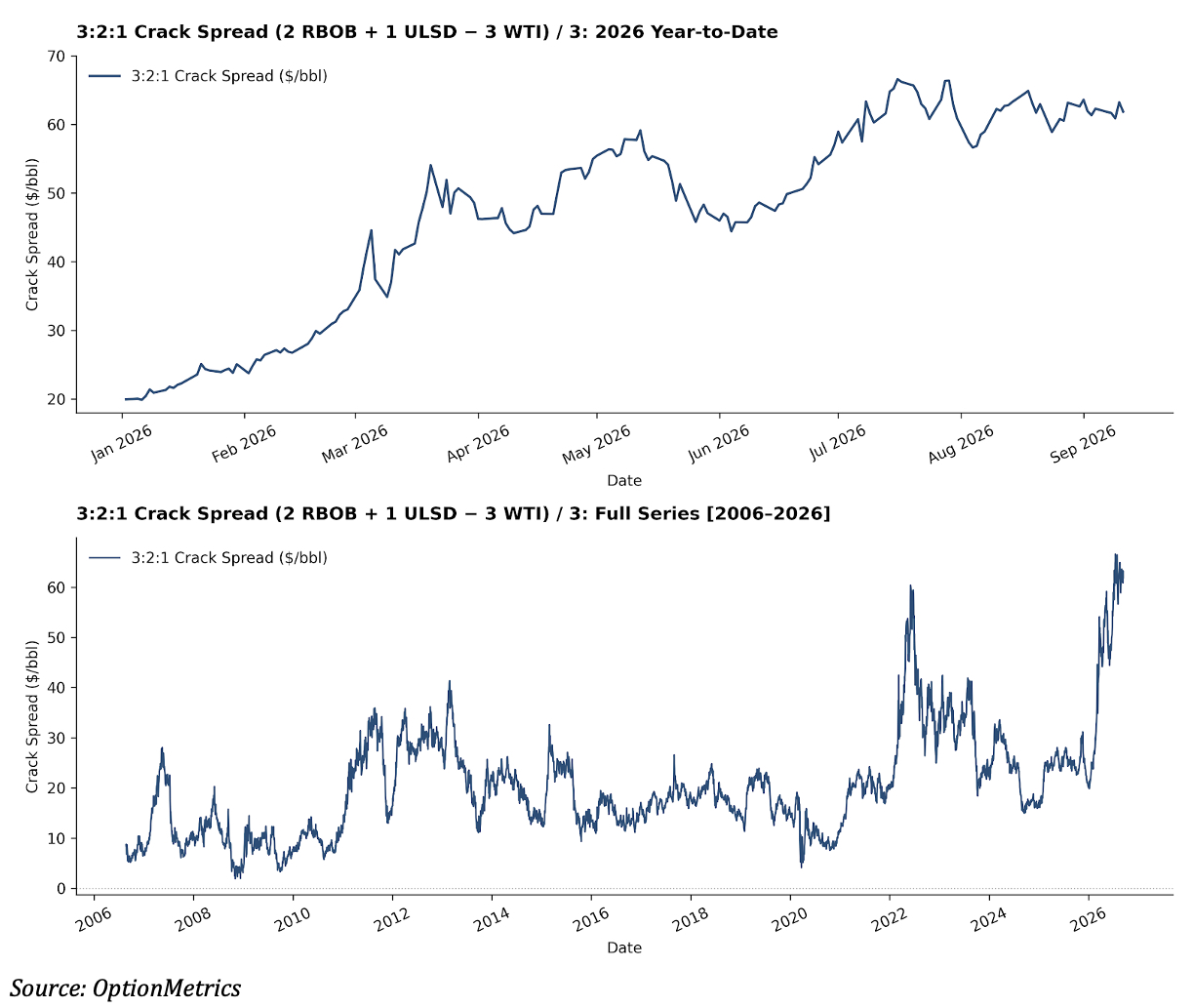
As a broader measure of refinery margins that includes gasoline, the 3-2-1 crack is used. In this case, the crack measures the input/output spread of a typical refinery: three barrels of crude are used to produce two barrels of gasoline and one barrel of distillate (diesel). Although the 3-2-1 leveled off in September, it is still very near the all-time record levels set back in August:
Crude oil is no longer the only, or even the best, gauge of stress in the energy complex. Refined products, especially diesel, are where tightness is most visible and economic pain is transmitted most directly. Consumers treat fuel prices as a proxy for inflation and economic health, and with midterm elections approaching, diesel’s surge is politically sensitive. They may read about crude, but they pay for diesel.