Oil is back in the news, and the situation seems very similar to that of last March: escalating hostilities, constraints in the Straits of Hormuz, and renewed prospects of a rapidly tightening supply situation. Crude oil has reacted accordingly and is up 16.9% (30-day continuous Brent futures) from its lows reached at the beginning of the month and a whopping 9.3% on July 13th alone (the largest single-day movement since 05/05/2020). At the same time, Brent’s implied volatility has increased 19.6 percentage points from the low at the beginning of July and stood at 53.6 % (30-day, P/C average) as of Friday’s close. It hasn’t been this high since early June. Apparently, the oil market slipped into complacency too early.
When the war peaked last March, the consensus narrative called for severe and prolonged supply shortages, sharply higher prices, and sustained volatility. As it turned out, crude oil’s performance met some of these expectations, but not all, especially when compared to other extreme periods such as the runup to the 2008 financial crisis or at the height of the pandemic. The comparison can provide some valuable insights into how it may perform during the current period.
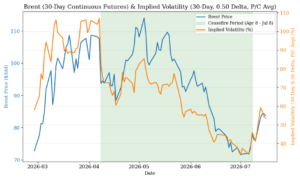
Despite the dire prognostications since the beginning of the war, Brent’s absolute price and volatility levels have not been notable on a historical basis. Frequent rumors of an impending ceasefire dampened both price and implied volatility. As the chart below shows, when Brent peaked in early May, implied volatility was 20 to 25 percentage points below its initial shock levels. By then, persistent cease-fire headlines had been absorbed by the market, and it was becoming clear that the extreme upside scenario was not materializing:
Source: OptionMetrics
Consider the following:
1) Brent (30-day continuous) peaked at $114.01 on May 4th. While elevated, that level did not rank among Brent’s 10 highest historical readings; since 03/04/2008, it was only the 288th highest and $32.37 lower than the all-time high of $146.38 recorded on July 3rd, 2008.
2) Brent’s implied volatility peaked on April 7th at 107.6%, which is only the 17th highest level ever recorded.
However, that is not to say that the period since the war began in late-February has not been more volatile than previous periods. Daily changes in both price and volatility reveal a different conclusion. three of the top-10 largest negative price changes since 2008 have occurred since the war began:
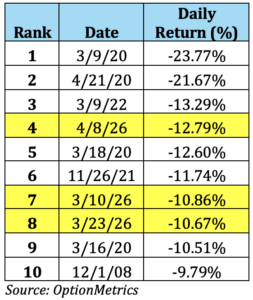
Despite the extreme negative swings, Brent did not register any Top-10 positive price changes since the war began. Apparently, the market was relieved that a cataclysmic supply shortage was avoided after all.
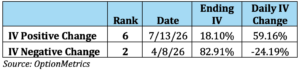
Changes in implied volatility were less impressive than price, but two registered in the Top-10 positive or negative changes since 2008:
It was generally recognized before the current hostilities that crude oil was at its most volatile during the height of the pandemic in March, April, and May of 2020. How does the period since the beginning of the war compare?
Using the metrics employed above, 2020 is still the most volatile of all time, and it’s not even close. One fact alone would be enough to settle the argument: on April 20th, 2020, crude oil settled at an astounding negative $37.63, a first for a mainstream exchange-traded commodity, and at an all-time record implied volatility of 153.9%. That’s a full 46.8 percentage points higher than when Brent implied volatility topped out at 107.1% last April 7th. And if that’s not enough, consider the share of Top-10 price and implied-volatility swings recorded from March to May 2020:
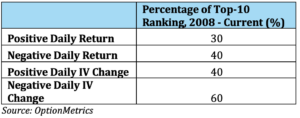
Clearly, the most volatile era for crude oil was during the height of the pandemic in March through April 2020. What can we take away from the comparison to the current period?
The current episode has produced historically large daily moves, particularly to the downside, along with a notable rebound in implied volatility. Still, neither outright prices nor volatility levels have approached the pandemic-era extremes. That could change, however, because the ceasefire did not allow enough time to ease supply pressures. In some respects, especially in refined products such as gasoline and diesel, conditions are even tighter. So far, prices and volatility have been restrained by the possibility of renewed negotiations or another ceasefire. If neither materializes, crude oil may be entering a more volatile regime. The pandemic era offers an extreme example of what could happen if hostilities continue to intensify.