The public markets may soon encounter one of the largest consecutive waves of initial public offerings in history. Companies such as SpaceX, OpenAI, Anthropic, and Databricks have all achieved extraordinary valuations privately, with several worth billions of dollars. SpaceX began strong with its IPO this June, raising a record $75 billion, which later increased to $85.7 billion amid very high demand. If a handful of these companies go public over the next few years, investors could be presented with an unprecedented opportunity to own a stake in businesses that have largely remained private. The excitement surrounding these upcoming listings is understandable. AI, cloud computing, digital payments, and satellite communications are among the fastest-growing industries in the global economy. Yet beyond the headlines lies a more important question.
Where is the money coming from?
Unlike typical IPOs, these companies will enter the market with valuations that rival those of some of the world’s largest public corporations. SpaceX alone has a market cap of $2.16 trillion (June 2026), while OpenAI and Anthropic continue to maintain enormous valuations as investors compete for exposure to AI. Although only a small percentage of shares are floated during an IPO, these offerings still require billions of dollars in investor demand. Institutional investors, fund managers, and retail investors all operate with finite pools of capital. While new inflows will undoubtedly help finance some offerings, many investors will also rebalance their existing portfolios. JPMorgan asset managers recently noted that, “although large IPOs are unlikely to permanently destabilize markets, some portfolio rebalancing should be expected as investors create room for new public companies. That process could produce short-term volatility across sectors that attract long-term investment.”[1]
For dividend investors, this distinction is important. The concern is not that mega IPOs will suddenly reduce corporate earnings or force companies to cut dividends. Instead, these listings may temporarily shift investors’ attention and investment capital toward a relatively small group of high-growth companies that promise future expansion instead of current shareholder distributions.
History shows that markets often reward compelling growth stories. Companies operating in artificial intelligence, cloud infrastructure, and space technology have captured enormous investor interest, as they are expected to reinvest nearly all available funds back into their businesses. Most of these companies are unlikely to pay meaningful dividends for many years. Investors purchasing shares in a future SpaceX or OpenAI IPO would not be seeking income; rather, they would be investing in the expectation of rapid future growth.
This presents a notable contrast to traditional dividend-paying sectors. Established companies in telecommunications, utilities, consumer staples, and real estate investment trusts typically generate substantial free cash flow and return a significant portion of earnings to shareholders through dividends. Their investment appeal is built on stability, predictable cash flows, and shareholder returns, rather than explosive revenue growth.
Consequently, this situation does not necessarily signal a competition between business models but rather a competition for investor capital. The telecommunications landscape offers an especially interesting example. Companies like AT&T and Verizon have long attracted income-oriented investors seeking reliable dividends and defensive characteristics. Meanwhile, communications technology is evolving rapidly. This evolution highlights the contrast between established dividend payers and emerging technology competitors. Historically, companies like AT&T and Verizon have drawn investors seeking predictable income rather than rapid growth. According to OptionMetrics’ Woodseer Dividend Forecast Data, AT&T maintained a consistent quarterly dividend of $0.2775 per share from 2024 through 2026, showcasing the stability that mature dividend companies can provide.
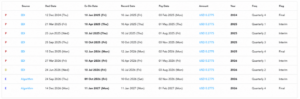
Source: AT&T dividends over the last 2 years OptionMetrics – Woodseer Dividend Forecast Data
Nonetheless, this consistency represents a distinctly different investment proposition compared to companies such as SpaceX. Investors who buy AT&T are mainly rewarded through recurring cash distributions, whereas those investors with future Starlink exposure would likely be investing in revenue growth, market expansion, and technological disruption, rather than immediate shareholder returns.
Verizon represents a different type of income investment. Rather than maintaining its payout, it has increased its dividend for 19 consecutive years. Its quarterly dividend rose from $0.69 to $0.71 in 2026, highlighting a commitment to steady dividend growth. Specifically, the quarterly dividend rose from $0.69 per share in early 2026 to $0.71 per share by August, continuing that streak. This makes Verizon a slightly different flavor of income investment than AT&T: not just a stable payer but a dividend grower, a business that models investor loyalty by steadily raising, rather than maintaining, its shareholder returns.
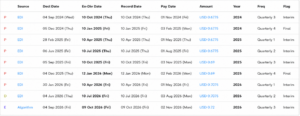
Source: Verizon dividends over the last 2 years OptionMetrics – Woodseer Dividend Forecast Data
This difference highlights the broader challenge posed by the impending wave of mega IPOs. The question is not whether companies such as SpaceX will directly threaten AT&T’s dividend.
Rather, the key question is whether investors will continue to value dependable income streams at the same level once some of the world’s fastest-growing companies finally go public. Over time, passive funds tracking those indices will need to buy new constituents. Although this process is designed to minimize disruption, repeated mega-IPOs over several years could gradually increase the concentration of investor capital among a handful of technology companies. Importantly, this should not be viewed as a prediction of widespread dividend reductions. Companies do not cut dividends simply because investors become interested in another stock. Dividend policies remain primarily driven by earnings, free cash flow, leverage, and long-term capital allocation decisions. A utility or consumer staples company with strong fundamentals is unlikely to change its dividend simply because OpenAI goes public.
However, valuation is crucial.
If investors become increasingly willing to pay premium valuations for high-growth companies while assigning lower multiples to slower-growing dividend payers, income-focused sectors may face a higher cost of equity over time. Companies may respond by emphasizing dividend growth, share repurchases, or other shareholder-friendly policies to remain competitive for investment capital. The broader point is that the next generation of technology IPOs is more than a series of exciting public listings; it reflects an evolution in where investors expect future value to be created. For more than a decade, many of the world’s most innovative businesses have remained private, limiting public market participation.
As these firms start to list on stock exchanges, investors will inevitably reassess how to allocate their portfolios between today’s reliable dividend producers and tomorrow’s potential market leaders.
For dividend investors, the key question is not whether SpaceX, OpenAI, or Anthropic will ever become significant dividend payers. Instead, it is whether their arrival as public companies will temporarily reshape the flow of capital across equity markets. The greatest impact of the upcoming IPO wave may not be on corporate dividend policies themselves, but rather on investor behavior—and in financial markets, where capital flows often influence valuations, that distinction may prove equally important.
[1] Mulvihill, Aaron, and Grant Papa. “How Might Mega-Cap IPOs Affect Markets?”
Citations:
Mulvihill, Aaron, and Grant Papa. “How Might Mega-Cap IPOs Affect Markets?” J.P. Morgan Asset Management, 8 June 2026, am.jpmorgan.com/us/en/asset-management/institutional/insights/market-insights/market-updates/on-the-minds-of-investors/how-might-mega-cap-ipos-affect-markets/.
Article written by Greer Webb. Greer Webb is a Washington and Lee University student originally from Lexington, Kentucky, USA.