Garrett DeSimone, PhD
Yvon Lu
Zero-day-to-expiration (0-DTE) options have exploded onto the SPX market, growing more than fivefold since 2022 and now accounting for over half of all SPX volume. Retail traders have driven much of this surge, but measuring exactly how much of the market is retail is surprisingly difficult. Options exchanges don’t publish account type or broker identity on the public tape, so retail trades must be inferred from characteristics like execution mechanism, size, and routing flags. Different methodologies can produce wide estimates ranging from 10% to 60% for the same market.
Cboe’s proprietary methodology (Xu, 2025) uses non-public data on broker identity, order origin, and account characteristics to arrive at a 50-60% retail share estimate for SPX 0-DTE trading. Our approach relies exclusively on public OPRA trade condition codes and produces a more conservative 30-35% estimate. The gap reflects definitional differences rather than measurement error: Cboe’s broker-identity methodology captures a broader retail population, including sophisticated retail on retail-classified platforms, while our approach identifies retail flow decisively through auction-routing patterns designed specifically for retail order flow.
The trade-off is precision versus coverage. Unlike Cboe’s proprietary approach, our construction utilizing IvyDB TradeFlow is fully reproducible; comparable across products and time periods; and aligned with established academic retail identification (Bryzgalova, Pavlova, and Sikorskaya, 2023)—enabling independent verification, applications to ETFs and single names, and real-time computation.
Retail Identification in SPY 0-DTE Options
The nature of zero-day-to-expiration (0-DTE) options requires a different retail measurement framework from what is traditionally applied to longer-dated contracts. Retail behavior in 0-DTE options differs from retail behavior in other expirations in two key ways that inform how retail flow should be identified.
First, retail 0-DTE activity is heavily concentrated in complex multi-leg strategies rather than single-leg positions. Cboe estimates that a significant portion of retail 0-DTE trading involves defined-risk multi-leg structures—most commonly short vertical spreads (put spreads and call spreads) and iron condors (Xu, 2025). These strategies offer retail traders defined maximum losses, reduced capital requirements relative to naked positions, and standardized risk profiles well-suited to the short-duration exposure of 0-DTE contracts. Retail automation platforms package these strategies as templates, reinforcing their prevalence in retail 0-DTE flow (Garcia-Ares et al., 2026) Therefore, Retail identification methodologies focused only on single-leg trades would miss a substantial fraction of true retail activity in 0-DTE options trading.
Second, the low absolute premium of 0-DTE options combined with their inherent leverage allows capital-constrained retail traders to trade in larger clip sizes than would be feasible in longer-dated options. This creates a size distribution for retail 0-DTE options trades that extends meaningfully beyond the strict 1-10 contract range typically used to identify retail flow in equity options studies. Active retail traders, or “Protail”, particularly those using automated platforms or day-trading 0-DTE strategies, could routinely trade in the 11-50 contract range.
Trade Condition Codes Used for Identification
Retail identification in OPRA transaction data relies on trade condition codes that indicate how orders were routed and executed. Four codes are relevant to our construction:
SLAN (Single-Leg Auction Non-ISO): Single-leg option trades routed through Cboe’s Automated Improvement Mechanism (AIM) or similar exchange auction mechanisms designed to provide price improvement for retail order flow. These trades enter a formal auction exposure period where market makers and other liquidity providers can improve upon the National Best Bid and Offer (NBBO).
MLAT (Multi-Leg Auction): Multi-leg option trades executed through auction mechanisms with a formal exposure period in the complex order book. These mechanisms include Price Improvement (retail-oriented), Facilitation, and Solicitation Mechanisms.
AUTO (Automatic Execution): Single-leg trades executed electronically without going through a formal auction mechanism. AUTO represents the broad category of automated electronic execution and includes multiple execution paths — trades taking displayed liquidity at the NBBO, trades receiving price improvement inside the NBBO through wholesaler internalization or exchange price-improvement programs, and various algorithmic executions against the electronic order book.
MLET (Multi-Leg Electronic Trade): Multi-leg trades executed electronically against the complex order book without going through a formal auction. Analogous to AUTO for single-leg trades but for multi-leg strategies.
Two Retail Measures
Utilizing these trade condition codes in TradeFlow, we construct two retail measures for SPY 0-DTE that differ in how broadly they define retail activity.
Narrow Measure (Measure 1):
SLAN (lot size 1-10) + MLAT (lot size 1-10) + AUTO (SIZE = 1) + MLET(SIZE=1)
Broad Measure (Measure 2):
SLAN (lot size 1-50) + MLAT (lot size 1-50) + AUTO (SIZE = 1) + MLET(SIZE=1)
The concentration of retail flow in SLAN and MLAT reflects the economics of payment for order flow (PFOF). Retail brokers such as Robinhood, Schwab, and E*TRADE route customer orders to wholesalers like Citadel Securities and Susquehanna, who pay for the order flow. Under best-execution obligations, brokers must seek favorable execution terms, and wholesalers commonly provide price improvement over the NBBO as part of their competitive offering (Bryzgalova, Pavlova, and Sikorskaya 2023). Cboe’s Automated Improvement Mechanism (AIM) is a price-improvement auction that allows wholesalers to facilitate retail-sized customer orders for SPX/SPXW; AIM eligibility is limited to 10 contracts or fewer during regular trading hours.
Not all retail routes through auctions, however, and the size = 1 filter on AUTO and MLET captures the non-auction retail population. One-contract trades are economically inefficient for most institutional flow, given fixed per-contract transaction and clearing costs, and institutional execution algorithms typically slice parent orders into larger contract clips to maintain efficiency. Retail traders, by contrast, commonly trade single contracts. Additionally, the size = 1 filter also captures retail flow from non-PFOF brokers that bypasses auction routing entirely.
SLAN and MLAT trades in the 11-50 contract range route through alternative auction mechanisms such as Solicitation and Facilitation, which serve a broader mix of institutional and retail customers. While this introduces some institutional contamination, the extension captures active retail traders using larger clip sizes that 0-DTE’s low premium structure enables—a substantial population the strict ≤10 filter would miss.
Retail Behavior and Time of Day
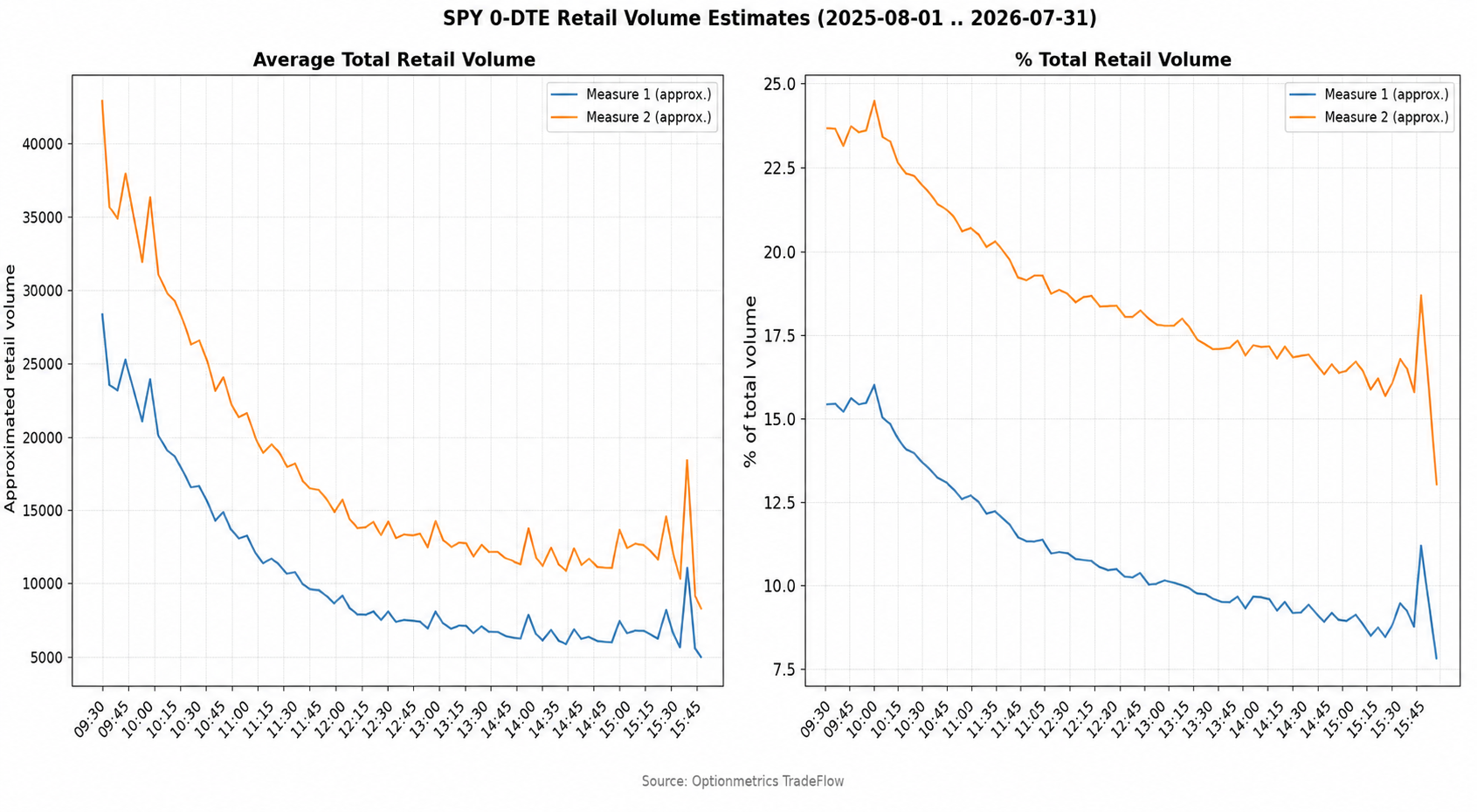
With these definitions, we study intraday retail activity in SPY. The chart below plots average SPY retail options volume in absolute terms (left) and as a share of total volume (right), recorded in 5-minute intervals over the prior year and averaged by timestamp. Measure 1 and Measure 2 correspond to two retail-identification tiers, bracketing a conservative-to-broad range.
The dominant pattern is a pronounced morning concentration followed by steady decay. Retail volume peaks at the open—roughly 28,000 contracts on Measure 1 and 42,000 on Measure 2—and falls by more than half within the first ninety minutes before flattening into a low midday plateau. As a share of total volume, it follows the same path, easing from about 15% and 23% at the open to 8% and 16% by late afternoon, with retail participation sitting in a 10–23% band for most of the day. This monotonic decline is consistent with the literature documenting that retail activity is heaviest in the morning, and because both measures preserve the same shape, the finding is robust to the identification threshold.
A distinct spike near 3:45 PM appears in both series before dropping into the close, consistent with 0-DTE positions being closed out ahead of expiration; its presence in the participation share indicates retail activity rises faster than total volume in that window.
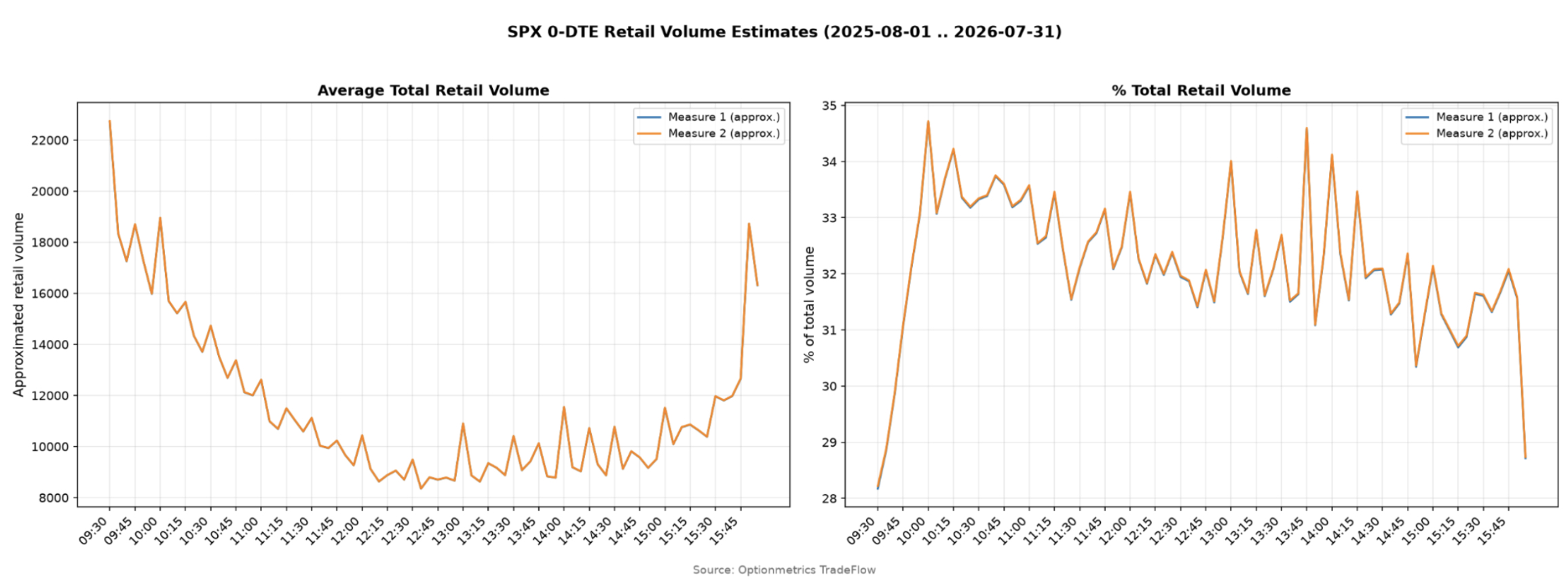
 Next we plot SPX activity below. The shape is distinctly different. Rather than decaying through the session, SPX retail volume traces a convex, U-shaped profile: heavy at the open, falling to a midday trough around 12:00–12:45, then climbing steadily into the close. In share terms, the pattern is even sharper—participation opens near 28%, jumps above 34% within the first half hour, and holds in a 31–34% band for the rest of the day, ending elevated rather than depressed.
This U-shape is consistent with Xu (2025), who documents that retail 0-DTE investors are active at both ends of the session so that the retail intraday profile mirrors the classic U-shaped equity volume curve. Crucially, Xu finds retail closing volume traces the same U-shape as its opening volume, the two overlapping for much of the day, implying retail both initiates and unwinds throughout the session. Institutional flow behaves oppositely: opening activity is heavily front-loaded (about 18% of all institutional opening trades in the first 30 minutes) and trails off, while closing activity stays roughly flat and well below the open, since institutions hold positions longer or hedge them by other means. That contrast explains the shape we observe: the afternoon build in our SPX series reflects retail re-engagement and position closing into expiration, not fresh institutional flow.
The two indices differ in shape but share a common feature in the retail-share series: in both, retail participation is highest in the first half hour and flat-to-declining thereafter, so the afternoon flow is disproportionately non-retail. In SPY, this appears as a steady decay in retail volume against persistent total volume. In SPX, total volume itself rebuilds into the close, but retail share stays flat (~31–34%), meaning that rebuild is substantially institutional. This is consistent with Xu (2025): retail remains active into the close, but in share terms that late activity is matched by institutional flow, so retail participation does not rise even as absolute volume does. The SPY case is the more striking—it points to heavier institutional involvement in SPY 0-DTE than its lower per-contract premiums might suggest.
Utilizing trade condition codes in IvyDB TradeFlow, we construct two reproducible measures that place SPX 0-DTE retail share at 30–35% — below Cboe’s broker-identity estimate by construction. Its advantage is reproducibility: comparable across products and time and extendable to ETFs and single names. The intraday evidence reinforces this—retail is front-loaded in both SPY and SPX, leaving the afternoon session disproportionately non-retail, a pattern visible only because the measure is computed consistently across products.
Citations
Bryzgalova, Svetlana, Anna Pavlova, and Taisiya Sikorskaya. 2023. “Retail Trading in Options and the Rise of the Big Three Wholesalers.” Journal of Finance 78 (6): 3465–3514.
Garcia-Ares, Pedro Angel, Diego Amaya, Neil D. Pearson, and Aurelio Vasquez. 2026. “The Rise of Algorithmic Retail Option Traders.” SSRN working paper. https://ssrn.com/abstract=6480379.
Xu, Mandy. 2025. “0-DTEs Decoded: Positioning, Trends, and Market Impact.” Cboe Volatility Insights, May 2, 2025.