Selling zero-days-to-expiration (0DTE) options has become a popular trading strategy with the potential to collect high premiums daily. A wave of daily and weekly income products has grown up around a simple pitch: theta decays fastest in an option’s final hours, so selling one that expires today should collect more premium per unit of risk than selling one that expires in a month and decays slowly. It sounds good in theory, but does it survive the transaction costs of rolling a position every single day? Using OptionMetrics’ IvyDB US – Intraday, we compare a 0DTE covered call to longer-dated covered calls that don’t require constant turnover and offer some recommendations to potentially improve returns.
For this backtest, we hold $1,000,000 of SPX notional and, every morning at 10 am, write a 25-delta call against it, priced at the bid to incorporate the spread cost into the trade. We run four strategies in parallel, varying only the time to maturity of the calls sold—0, 5, 10, and 30 DTE—holding each option until expiration and marking positions to market daily. We conduct this strategy back through time when 0DTE options were first introduced in May 2022.
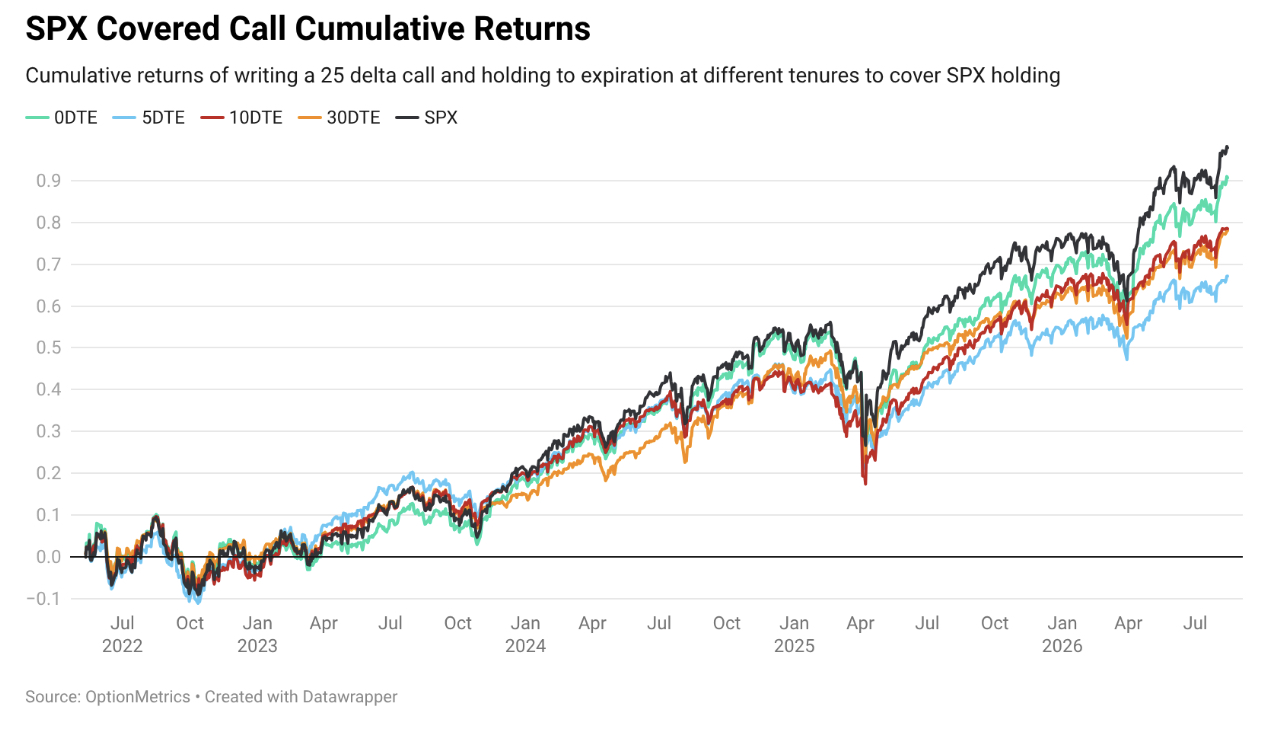
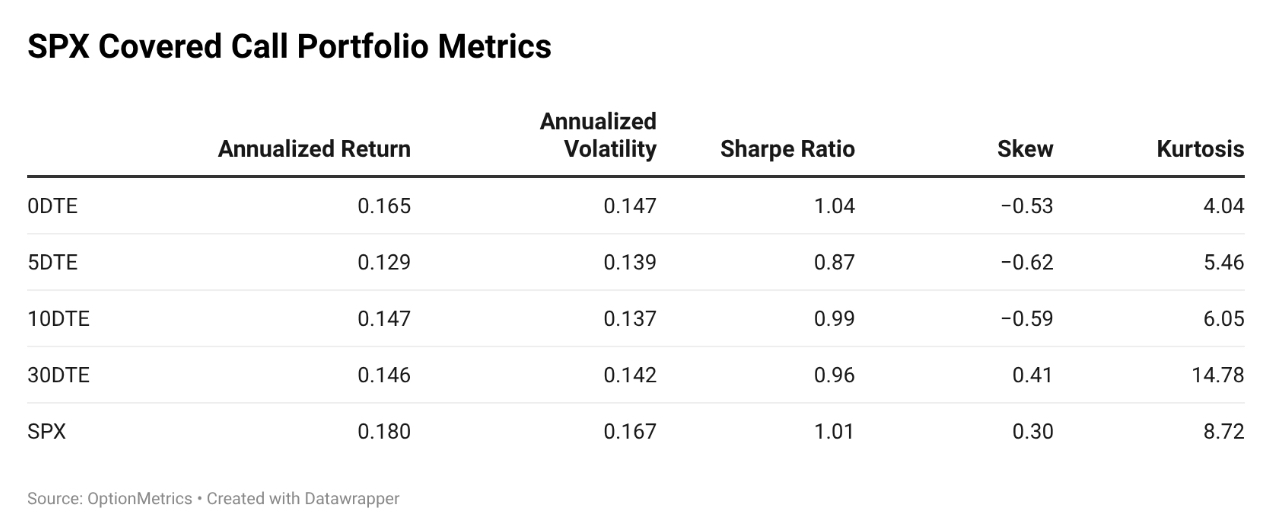 The chart above shows the cumulative returns of these strategies, alongside a simple buy-and-hold SPX strategy for comparison. The ranking supports our theory: 0DTE has the best CAGR (16.5%) and the best Sharpe (1.04) of the four. But the margin is thin, just 1.9% of annualized return and 0.08 of Sharpe over 30DTE. The risk profile isn’t obviously better either. 0DTE and other short-term calls have a negative skew, the classic short-gamma signature of small steady gains punctuated by sharp down days, while 30DTE skews positive but carries by far the fattest tail (kurtosis 14.8) from monthly gap risk. Interestingly, selling a 5DTE call is the worst-performing strategy in this analysis. Since a 5-day call will always encompass the weekend while a same-day call does not, this implies that the 5-day risk premium likely does not price in enough of a gap risk to compensate for the weekend exposure that comes with a 5-day option. This is not seen in the 30-day call strategy since a majority of the remaining theta can be attributed to trading days.
It is worth mentioning that buy-and-hold SPX returns have a positive skew, as this backtest period from mid-2022 to present is in a strong bull market with very few sustained drawdowns. Because of this, it is very difficult for a covered call strategy to outperform buy-and-hold since it caps upside gains. Usually in a sideways or bear market, these covered calls outperform buy-and-hold.
The marginal gains of the daily version of this trade are likely not worth building over its less transaction-heavy monthly cousin. If a 0DTE strategy is going to earn its keep, traders need to be selective about which days they sell the call option.
A covered call performs best when call premiums are rich, and one way to gauge that is through skew: the difference between the implied volatility of a 25-delta put and a 25-delta call. Since we are focusing on selling 0-day calls, we will calculate the 0DTE skew. High skew means OTM calls are relatively cheap compared to OTM puts; low skew means the opposite. For longer-dated maturities, IV Skew runs structurally positive for SPX, which is due to the fact that institutions hedge broad portfolio downside risk via OTM puts. However, ultra-short SPX skew can go negative when near-dated upside demand increases as a result of dealer short-gamma covering or relief-rally flow.
To build this into the strategy, at 10 am we calculate SPX 0DTE skew. The strategy is then conditional:
1) Sell a 25-delta covered call if skew is below 3% (the median skew value)
2) Maintain a long SPX uncapped SPX position if SPX skew is above 3%.
This strategy eliminates roughly half of the trading days and sells calls only when they are relatively expensive.
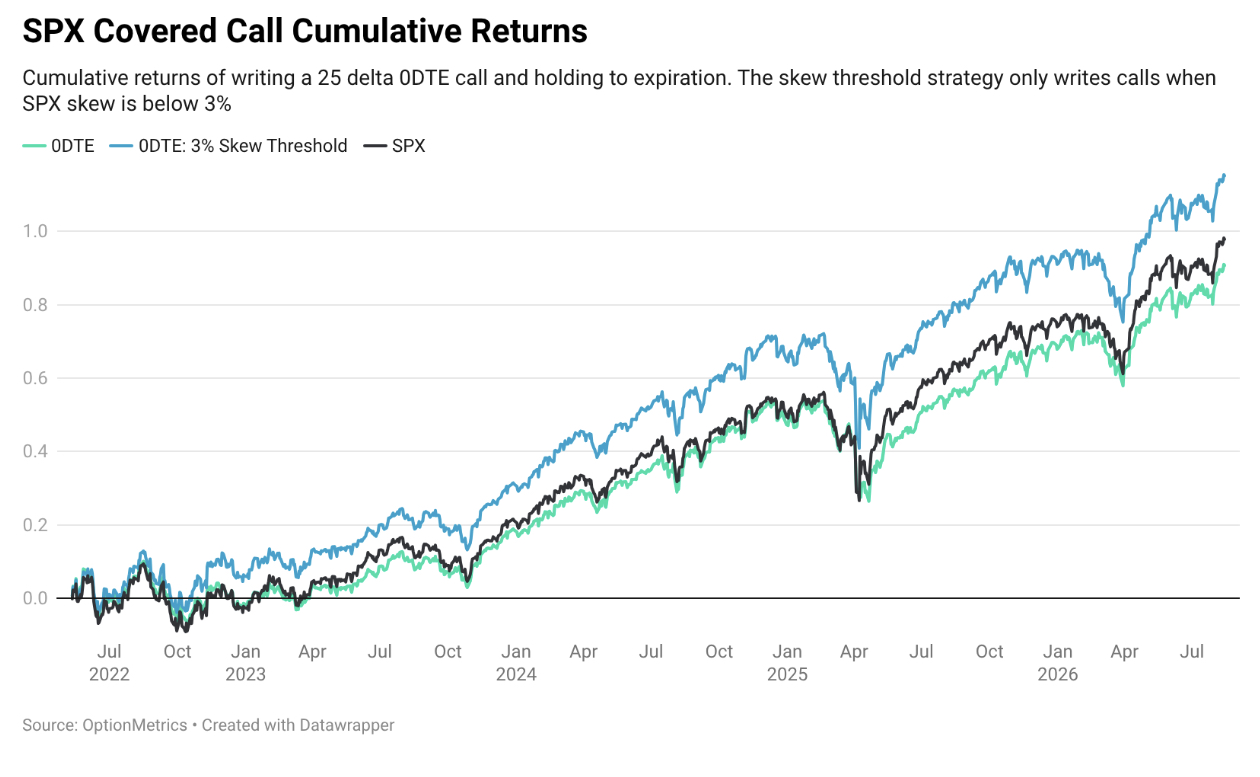
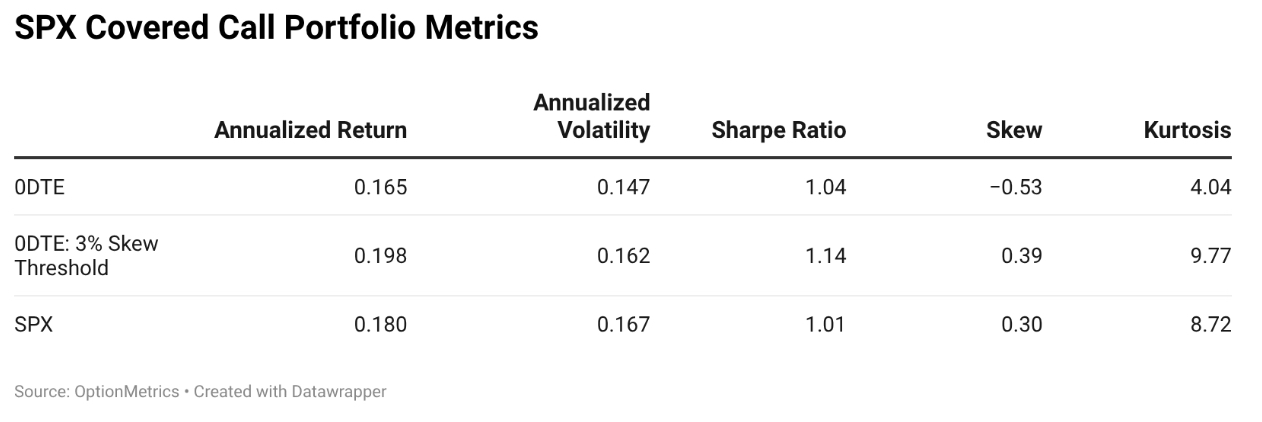
The graph above compares the 0DTE covered call strategy run across all trading days against the same strategy run only when skew is below the 3% threshold.
A 3% skew threshold lifts CAGR from 16.5% to 19.8% and Sharpe from 1.04 to 1.14. Most importantly, it does so while cutting the amount of option trading in half, meaningfully reducing the implicit transaction costs this study doesn’t otherwise account for. It even beats buy-and-hold SPX on a risk-adjusted basis (1.14 vs. 1.01 Sharpe), since it doesn’t cap the upside as often and only writes calls when doing so is economically meaningful.
In the above analysis, we show that sold blind, 0DTE isn’t a compelling structure on its own: the daily-versus-monthly edge amounts to a couple of CAGR points, bought with worse skew and 21 times the trading. What makes it worth building is conditioning the trade on whether the call premium is rich enough to sell, a filter that lifts returns while cutting the stress and cost of daily turnover.