On January 20, 2026, Mark Carney, prime minister of Canada, used his Davos Congress speech in Switzerland to call for an alliance of middle-power countries, reflecting a growing concern that dependence on the world’s largest powers could become an economic and political liability.
Countries such as the UK, Canada, Japan, South Korea, Australia and members of the European Union possess substantial economic resources, technological expertise, and industrial capacity. Carney’s proposal suggests that by coordinating trade policy, diversifying supply chains, and pooling investment, middle powers could strengthen their bargaining position and reduce their exposure to the potential for economic coercion.
The ambition is not necessarily to turn away from Washington or Beijing, of which the vast majority of the world is dependent. Rather, it is to ensure that relationships with either superpower do not become a source of vulnerability.
For investors, the stakes extend beyond geopolitics. A more resilient global trading system could help steady corporate earnings and strengthen cash flow, with important implications for companies’ ability to sustain and grow dividends.
The dividend connection: why investors should pay attention
For dividend investors, the significance of a middle-power alliance lies in its potential effect on the profits and cash flows from which dividends are paid.
Companies with diversified markets and more resilient supply chains may be better equipped to withstand tariffs, export restrictions, and geopolitical shocks. More stable earnings could, in turn, improve a company’s ability to maintain shareholder distributions.
The relationship could be particularly relevant in capital-intensive sectors such as energy, mining, telecommunications, and manufacturing, where dividends often depend on the durability of operating cash flow.
Consider a Canadian mining company that sells most of its output to US customers. If trade restrictions reduce demand or weaken the prices it receives, revenue and cash flow could deteriorate, putting pressure on dividends.
A company with established customers across Europe and Asia might have more options. It could redirect some exports or negotiate alternative supply agreements, potentially reducing damage caused by a disruption in one market.
The outcome would not necessarily be higher profits. Transport costs, different pricing conditions, and the expense of developing new commercial relationships could offset some of the benefits. But a broader customer base could reduce the risk of a single political decision undermining a company’s ability to pay shareholders.
The same logic applies to manufacturers reliant on imported components. Alternative suppliers could help limit production interruptions and stabilize operating costs, making dividend payments less vulnerable to sudden shocks.
Which sectors could benefit?
Energy and mining: Producers with access to diversified export markets could benefit from stronger trade links and investment in strategic resources. However, their dividends would likely remain sensitive to commodity prices, capital expenditure, and government policy.
Manufacturing and automotive: Companies able to diversify both suppliers and customers could become less exposed to tariffs and concentrated production networks. The cost of restructuring supply chains could weigh on earnings in the short term.
Telecommunications: More resilient technology and equipment supply chains could reduce disruption, although dividend capacity would likely continue to depend on debt levels, competition, and capital investment.
Banks and financial services: Stronger cross-border investment and business activity could support lending and fee income. Conversely, trade disputes and economic slowdowns could increase loan losses and weaken dividend coverage.
Technology and semiconductors: Collaborative research and investment could create long-term growth opportunities. Yet the substantial cost of developing new technologies and manufacturing capacity could limit near-term cash available for dividends.
Renewable energy: Greater cooperation on batteries, critical minerals, and clean-energy technologies could expand markets and investment opportunities. Returns, however, may take years to materialize and depend heavily on policy support.
These are potential channels of impact, not guaranteed investment outcomes. The effect on individual companies will depend on their geographic exposure, competitive position, financial strength, and capital-allocation decisions.
Rio Tinto—a mining and metals company, listed on several exchanges, has previously declared dividends in the Great British Pound (GBP) and is known to also have declared dividends in multiple other currencies (+3). Most recently, it has become increasingly dependent on declaring dividends in US dollars, versus other currencies, which might make it appear less multinational in scope.
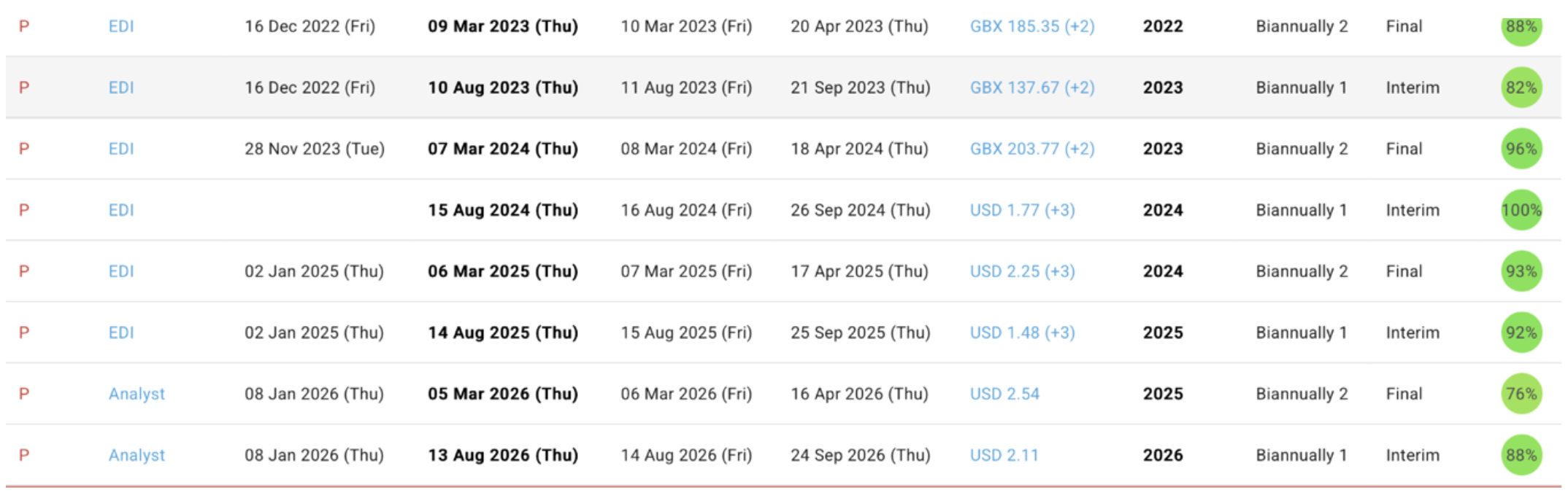 Source: OptionMetrics, Woodseer Global
Mercedes-Benz: Dividend Declines Highlight the Risks of Global Trade dependence
Mercedes-Benz—since the introduction of tariffs, it has seen a large decline in its dividend. An alliance of middle powers may help to insulate the company from the consequences of tariffs imposed by a global economic superpower.
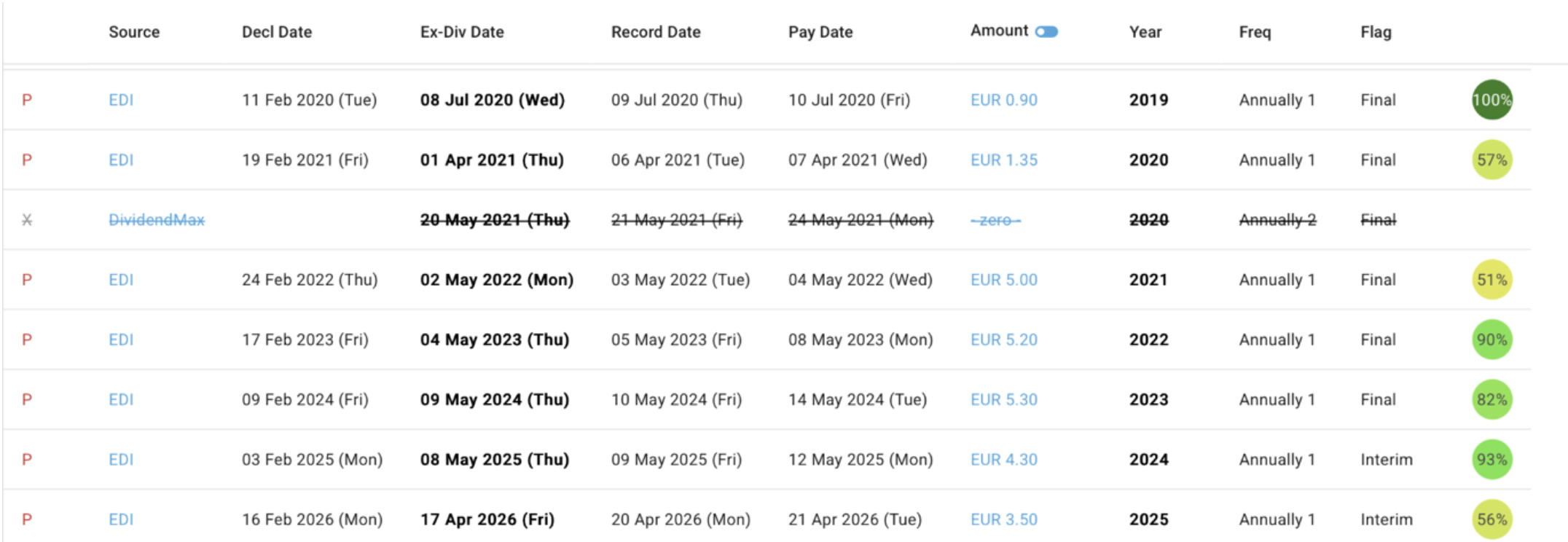 Source: OptionMetrics, Woodseer Global
A stronger economy does not automatically mean higher dividends.
There is an important distinction between improving a company’s resilience and increasing the amount it pays shareholders.
Even if a middle-power alliance creates more trading conditions, businesses may choose to use additional cash flow to reduce debt, fund expansion, strengthen their balance sheets, or invest in new technology.
For investors, the quality of a dividend therefore matters more than the headline yield alone.
A company offering a 7% yield may be less attractive than one yielding 4% if the higher-yielding business has weak cash-flow coverage, substantial debt, or excessive exposure to a vulnerable market.
Investors should examine the proportion of earnings distributed as dividends, free cash flow after capital expenditure, debt obligations, geographic revenue concentration, and the company’s record of maintaining distributions through economic downturns.
Geopolitical resilience is best viewed as one part of a broader assessment of dividend sustainability.
The bottom line for dividend investors
Carney’s proposal faces significant hurdles.
However, if countries can diversify their trading relationships, coordinate strategic investment and build more resilient supply chains, businesses may become less vulnerable to disruptions originating with superpowers in the US or China. For some companies, that could translate into more predictable earnings, stronger cash-flow resilience, and a greater capacity to maintain dividends through periods of uncertainty.
But the relationship is indirect. An alliance would not guarantee higher corporate profits, and more stable profits would not automatically lead to larger shareholder distributions.
For investors, the more useful question is which companies are best positioned to benefit from a less concentrated global economy. Businesses with diversified customers, reliable suppliers, strong balance sheets, and dividends supported by sustainable free cash flow may be better placed to navigate geopolitical change.