In evaluating the value of investments in different stocks and the dividend payments companies make, equity dividend analysts often weigh several factors. These may include:
- The formulaic approach of investing in a “safe” company that tends to pay a consistent dividend, albeit without a significant increase year-over-year.
- Or conversely, investing in companies that are consistently generous dividend payers with growing share prices. Games Workshop, growing from 11,600 GBX to 22,000 GBX over the past 5 years with celebrity endorsers such as Warhammer superfan Henry Cavill, is an example of this.
In an ideal world, dividend payments would follow a formulaic pattern, a consistent rise year-over-year based on reliable growth and, ceteris paribus, all external factors having minimal, if any, impact on the company in question. The reality is, of course, different; there are meteoric rises, high expectations that simply do not come to fruition, and surprise packages that explode onto the market.
Crises can transcend the risk-benefit system by rendering what can seem like a safe investment for dividend rewards completely destitute. Stable stocks, or ‘safe bets,’ still exist in abundance, but what happens when presumedly safe stocks are hit by a crisis beyond any formulaic calculation or analytical module, and what consequences does this have for a dividend forecaster?
Prior to 2020 the aviation and hospitality sectors both represented stalwart dividend investments. Delta Airways and Compass Group hospitality both paid growing dividends year-over-year and would, to any rational investor, seem like a reliable investment with solid dividend returns. The necessity of society to need travel, to host social events such as weddings, or, simply, to visit a supermarket without having to keep a perimeter of distance between yourself and others was a given. As we know, COVID-19 changed all of this, and with it came unthinkable consequences to the global economy and to the aviation and hospitality sectors. With little choice, dividends being a luxury for shareholders, the aviation and hospitality sectors uniformly cut all of their dividends for the foreseeable future. The unanimity of these sectors made the cuts easy to predict.
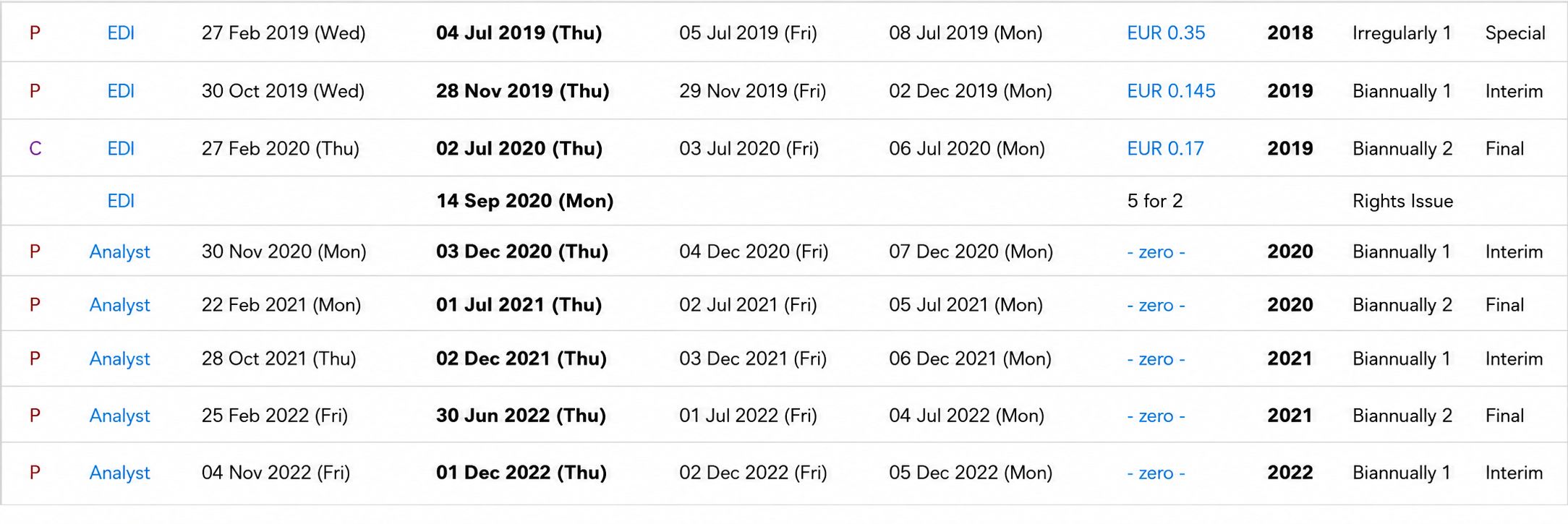 Source: Delta Airlines dividends 2018-2022. Chart courtesy of OptionMetrics – Woodseer Forecast Data
In October 2022 Adidas was hit by the “Adidas-Yeezy crisis”. Adidas, following antisemitic remarks from global artist Kanye West, was forced to split their lucrative partnership. The fallout was a loss of €1 billion in retail value, which caused Adidas’ stock to plummet and contributed to the sportswear giant’s first annual loss in over three decades. This led to Adidas making an unprecedented dividend reduction for the first time in its history.
The crisis left equity dividend analysts with a decision to make. Adidas remained a massively reputable sports brand retailer, but in a time of vulnerability, the dividend was the first thing to go. What would Adidas’ dividend future look like? Would the company retain the low dividend, or would it take the initial hit and then quickly return to paying shareholders as per before? Would Adidas gradually return to paying shareholders the previous dividend over several years?
The resolution for the company was to forecast a return to form, not gradually but not too rapidly. Adidas maintained its dividend at 0.70 cents per share for 2024, then increased dramatically to 2.00 euro in 2025, and 2.80 euro in 2026. Our dividend forecast team has forecast a full return for 2027 of 3.30 euro.
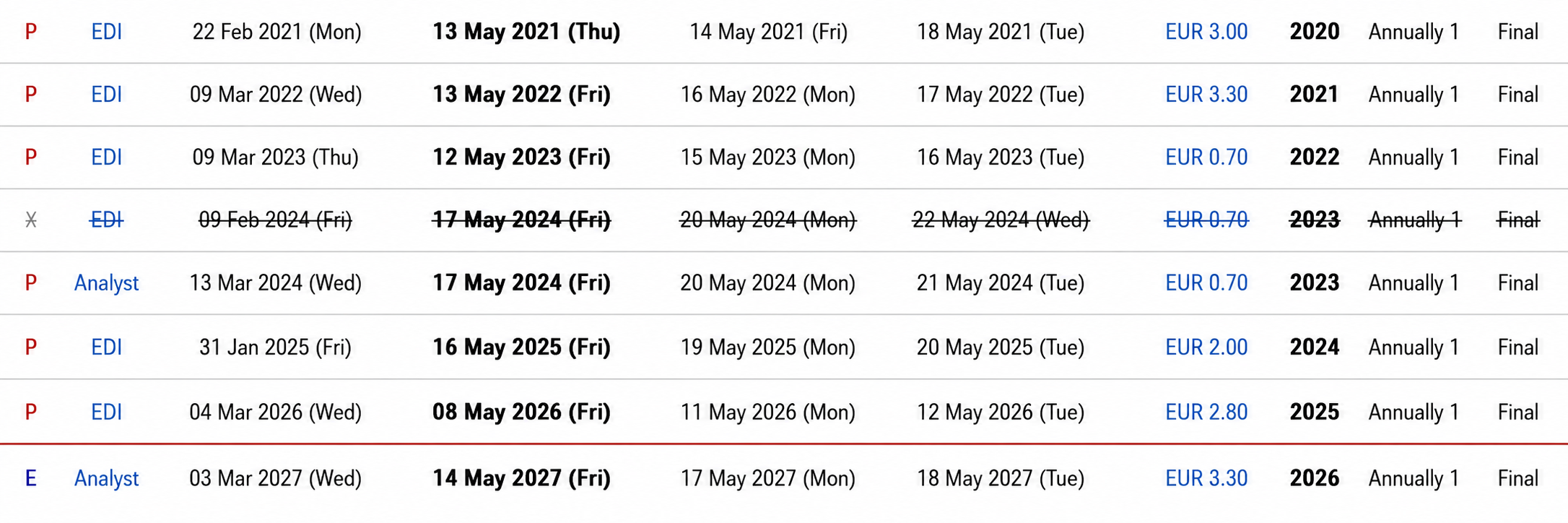 Source: Adidas dividend payments 2021-2026, image courtesy of OptionMetrics – Woodseer Dividend Forecast Data
The latest test for dividend forecasters has come in the form of the conflict involving Iran, a geopolitical crisis that has sent ripples through several strategically important industries. While energy markets have understandably dominated headlines, the fertilizer sector has emerged as one of the more exposed industries due to its reliance on supply chains linked to the Strait of Hormuz. Natural gas remains the primary feedstock for nitrogen fertilizers, while an estimated quarter to a third of global fertilizer exports typically transit the waterway. The industry is also highly seasonal, meaning that prolonged supply disruptions can have significant consequences for agricultural production and food security.
Not all companies have been affected equally. CF Industries has benefited from its reliance on domestic natural gas supplies in the United States and Canada, while Nutrien has been supported by higher fertilizer prices and the resilience provided by its diversified agricultural retail business. By contrast, The Mosaic Company has faced more direct pressure. Since late February, its share price has fallen from approximately $27.84 to $22.44 as higher sulphur costs—driven by supply constraints in the Persian Gulf—have compressed margins faster than the company has been able to pass increased costs on to customers. While the decline is far from catastrophic, it represents a material deterioration in profitability. As a result, we have incorporated a modest reduction in our dividend forecast to reflect the increased near-term uncertainty.
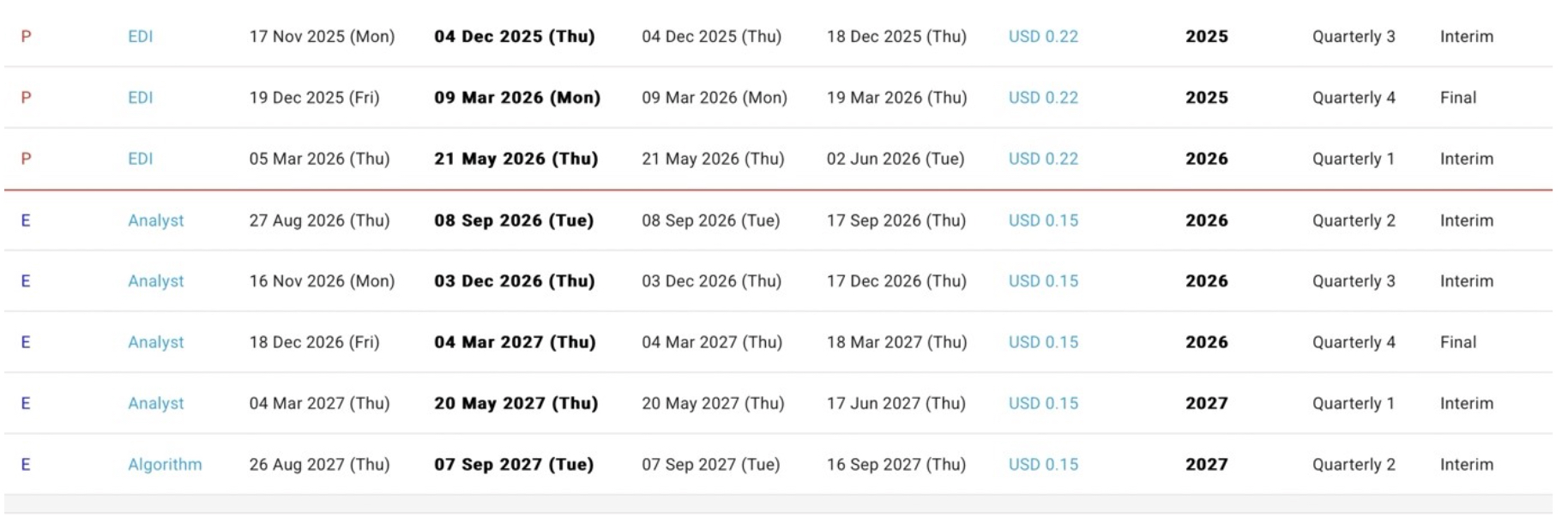
Source: Mosaic Company dividend payments 2021-2026, image courtesy of OptionMetrics – Woodseer Dividend Forecast Data
Dividend forecasting has never been an exercise in simply extending historical trends. Every crisis—whether a global pandemic, a corporate reputational shock, or a geopolitical conflict—forces dividend analysts to reassess assumptions and distinguish between temporary disruption and lasting structural change. The challenge is not to predict every unexpected event but to judge how companies are likely to respond when those events occur. Ultimately, successful dividend forecasting depends as much on informed judgment as it does on financial modeling, combining market intelligence with a clear understanding of how resilient businesses are when tested by circumstances beyond their control.